
Rugby: Taranaki’s unbeaten 1976 season remembered 50 years on
Thursday, Oct 01 2026
Ian Snook
50 years ago. It’s a long, long time.
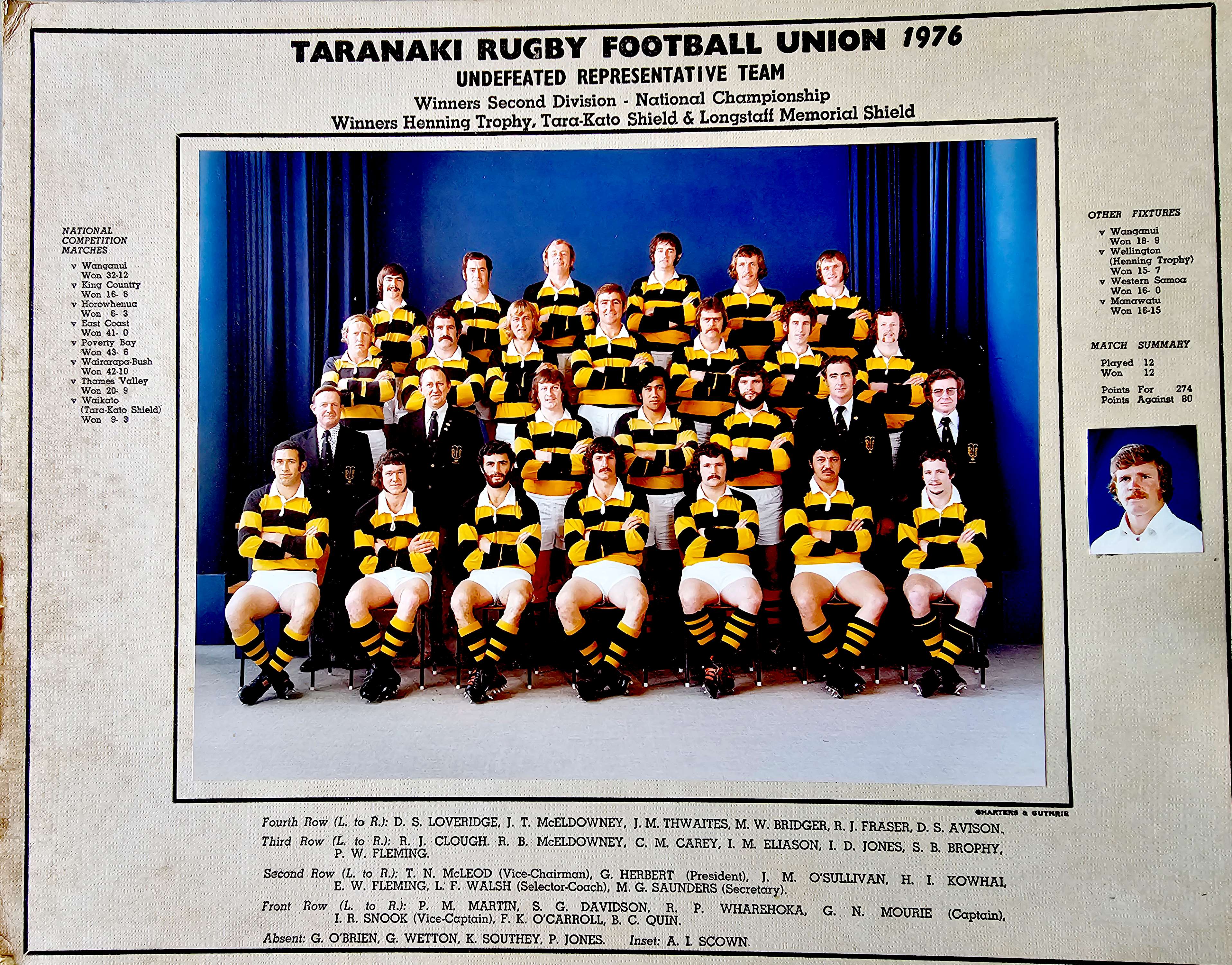
Rugby players had long hair, they wore black boots, they were presented with one tie that they mustn’t lose, they were promised petrol money for travelling to training and games, which most of them are still waiting for, they had jobs outside the game, and they just loved playing.
Some lucky ones were selected for Taranaki, where undoubtedly a bond would grow, and memories would be created. Occasionally the memories would leave a deep impression.
Taranaki’s 1976 season was one of these seasons for many of those players chosen.
This was the first time that the NZRU introduced a competitive format throughout the country. Prior to this, games were played on a ‘friendly’ basis, maybe with the winning or losing of a cup or a shield, with the only games of any significance being played in Ranfurly Shield clashes.
It was a major step into the new world. Games had a distinctive ‘win’ or ‘loss’ feel about them and there would be consequences, both good and bad.
The introduction of the National Provincial Championship certainly struck a nerve with Taranaki rugby people. The team were placed in the second division.
The province was in a furore. Legendary Taranaki figures such as Ross Brown had headlines pasted all over national newspapers. How could this happen?
Taranaki’s less than commanding performances over the previous seasons, admittedly mainly playing against the bigger and stronger unions, plus the perceived need to have South Island teams in Division One, had placed them, along with another biggie in Waikato, in a group consisting of Wairarapa-Bush, Whanganui, King Country, Poverty Bay, East Coast, Thames Valley and Horowhenua.
But make no mistake, these were the days when major provinces could trip up against any of the perceived lesser unions if they weren’t ‘on’ their game. Whanganui in fact started the ’76 season with wins against Manawatu and Wellington and looking a few seasons ahead Wairarapa would be third placed in the top division.
But it was still galling to see the likes of Marlborough, Southland, Otago, Counties and North Auckland in Division One alongside Manawatu, Bay of Plenty, Auckland, Canterbury, Hawkes Bay and Wellington.
In Division Two South, the teams were Nelson-Bays, Mid Canterbury, South Canterbury, Buller, North Otago, and West Coast.
What the Taranaki public did know was that the winner of Division Two North would replace the bottom Division One team for 1977.
The goal was obvious. Win division two. This would almost certainly mean a victory against Waikato at Rugby Park, Hamilton, in late September.
With the Taranaki Rugby Union needing to take the lead and smash into the season at full pace, they made an enlightened decision that set up the team for success – Leo Walsh was named the first ever sole selector-coach.
Goodness knows what went on behind the scenes, but Walsh was going to be the ‘man’. He had already proved himself with the Taranaki cricket where the team had staved off twelve Hawke Cup defences over three seasons, and now it was time to weave his magic with the rugby boys.
He was a wily customer with a sharp analytical brain, was a very astute selector, and key to it all, he was a ‘reader’ and manipulator of the sportsman’s mind.
Even the most experienced Taranaki players did not get too comfortable in their positions. Whatever it was, players wanted to perform for him.
Walsh immediately made his best ever decision – Graham Mourie was appointed captain.
Whether Mourie was enticed back from Wellington where he had had played a handful of games, or had already decided to join the healthy band of farmers that dominated the Taranaki team at the time, I’m not sure. Whatever the reason, the ‘Mourie Decision’, proved to be a coup for Taranaki and a positive step in Mourie’s career.
In time he would be regarded as one of the all-time greats as an All Black captain.
If the pointy end of the arrow was sharp with Walsh and Mourie in place, the body would prove to be strong and powerful.
Twenty-eight players performed in the twelve games with thirteen players running on ten or more times.
All twelve games were won.
As was normal for the day, a dozen players ran on three or less times. Impact from the bench was for injured players only in 1976.
The Taranaki pack was the ‘supporters delight’.
Muscle, athleticism and rugby IQ was sprinkled throughout the group. There were no weaknesses.
The legendary McEldowney brothers, John on the loosehead and Bryce on the tighthead, fronted a scrum who feared no-one.
In the tight exchanges they were good operators with a strong physical presence and mental toughness. Both men started all the games.
John, selected initially at 19, would play 125 games for Taranaki and another 12 for the All Blacks. Bryce ticked over 75 Taranaki games.
Settled between the McEldowneys was Maori All Black and Taranaki centurion (128 games), Felix O’Carroll.
He had it all. A very accurate thrower, a strong scrummager, and a good ball player, he was full of energy and skill.
Providing the grunt behind the front three were two neighbouring farmers from Central Taranaki. The legendary Ian Eliason and his off-sider the bruising and battling John Thwaites, would lock the Taranaki scrum together on 112 occasions, surely some sort of provincial rugby record.
The taller Eliason, made up of wavy arms, pointy elbows and long legs, proved his ability time and time again, eventually playing for a phenomenal eighteen seasons and clocking up a Taranaki record 222 games in the amber and black.
Toss in another 19 All Black games and he was forever drying and cleaning those boots.
His partner in crime, the slightly shorter but more aggressive Thwaites, was a tight forward who loved his work. In fact, the tougher the contest, the bigger the smile.
Thwaites was another of the eight in the 1976 run-on fifteen who would end their careers as centurions, playing 121 games.
Eliason started all twelve games in ’76, with Thwaites missing one.
The explosive spine of the team was the backrow.
To piece it together Walsh cleverly placed All Black Alistair Scown, normally a lightening fast openside flanker, into the number eight position. Here he wreaked havoc all over the park and was instrumental in a good amount of the Taranaki attack.
Walsh’s decision was so successful that Scown was named as one of ‘The Five Players of the Year’ in the Rugby Almanack’.
Diving on every loose ball, smashing into every ruck and tackling any opponent in close proximity, Ross Fraser was the archetypical blindside flanker, a player who could perform in the tight and in the open.
And he was relentless.
Named as an All Black in 1979 he then missed playing in the jersey through being injured, but he represented the North Island on three occasions, was another Taranaki centurion, and was a New Zealand surf life saver.
The man making the big calls and catalyst for the positivity, team collaboration and cohesion, was openside flanker and captain Mourie.
He would play 104 times for Taranaki, 61 times for the All Blacks and in 238 first class games overall.
Mourie’s presence and leadership manner, along with his game understanding and skill execution, placed him at the top of the pile.
He would miss the first game of the season but play the rest, meaning that during the season the same forwards only missed seven games amongst them.
There was plenty of quality covering the forward positions even if 76 wasn’t a big year statistically for these individuals. Reserves waited for their opportunities fifty years ago.
Loosie Gavin Wetton would eventually play 79 games; lock Mike Bridger would play 61 times; prop Emmett Fleming ran on 58 times and loosie Joe Carey would play 35 games.
The two Jones boys, Ian from Star, and Peter from Okato, covered the hooking position, Peter played in the exciting win against Wellington and Ian playing in three consecutive competition matches.
If Mourie was the master of the show, then Dave Loveridge at halfback was the Master’s Apprentice.
Loveridge was in his early days in the Taranaki strip, but his classy displays soon had him in an All Black outfit, where he was often described as one of the greatest, most complete and versatile of All Black halfbacks.
He would finish his career with 136 Taranaki games, 24 All Black tests, and 222 first class games.
Another huge backline presence was second-five Paul Martin, a talented attacker, clever tactician, accurate kicker and versatile player, he was able to play at a high level whether first-five, second-five or fullback.
Martin was awarded 125 Taranaki caps during his career, three Southern Zone Maori caps, and was also a Taranaki cricket and golf representative.
His experience was a crucial factor in pressure times.
At centre was Hawera halfback Paul Wharehoka.
Too good to leave out but not quite in the Loveridge class as halfback, it was a masterstroke from Walsh to whack number 13 on Wharehoka, where he ran like the wind and tackled like a kamikaze pilot.
A 95-game man he also represented Southern Maoris.
Taranaki were one of the leading try scoring teams that season, and dotting them down furiously were wingers Stephen Brophy and John O’Sullivan.
Missing only one game each Brophy ran in for eight and O’Sullivan scored six. Next in the list was Scown with four.
Brophy was an elusive runner and clever thinker whist O’Sullivan was hard out and bruising.
The fullback position was fought out between two young Stratford players Stephen Davidson and Dennis Avison, with Avison’s consistency and accurate goalkicking eventually winning the role.
It would be Davidson though who ended up with 85 Taranaki caps, 596 points, and an All Black trial.
And standing in the middle of it all, being heckled in the friendliest manner by Murray Cox and his mates in the terraces, and chastised for the amount of kicking, was first-five Ian Snook.
Many pundits would have been surprised when Walsh pulled another surprise and named Snook, at that time with only six caps under his belt, as vice-captain in this quality laden team, but with so much maturity and experience in the group, it was not a demanding task.
This was a team with built-in leaders.
Snook was the strategist. Things ran to a simple plan.
Fullback Rodney Clough, winger Gary O’Brien, centre Herbie Kowhai, halfbacks Peter Fleming and Kevin Southee, and first-five Brian Quinn who ended his career with 88 caps, all had a run on at some stage.
There was plenty of talent in this group.
As well, there were good people on the fringes with the likes of President Geoff Herebert, Chairman Nigel McLeod and manager Jock Richards, true rugby men to the core. All played their part.
Things were in place. There were non-competition games against Whanganui, Wellington, Western Samoa, and Manawatu to deal with and the important NPC games.
The NPC was a ‘must win’ scenario.
When you look at these opponents nowadays it is a head shaker to think that many of these games could even get close, and although they were generally comfortable, Horowhenua rocked up to Rugby Park, played out of their skins against a poor performing Taranaki, where the locals luckily salvaged a three-point win.
Three early season friendlies were won against Whanganui (18-9), Wellington at Hawera (15-7), and Western Samoa (16-0).
I can still see Avison making two try saving tackles on Wellington winger Bernie Fraser as he raced for the corner at Hicks Park. This was no mean feat on a windy Hawera day where play hugged the grandstand touch for much of the game.
The NPC kicked off with a win at Spriggens Park against Whanganui 32-12 which was comprehensive and satisfying considering Whanganui had headed into the game following victories against Wellington and Manawatu.
The result was a confidence booster and already there was a quiet belief that the team were on the right path.
King Country was a handy game to have at home and were beaten 16-6, followed by the nightmare against Horowhenua with a 6-3 victory at Rugby Park.
Leo (Walsh) was not a happy camper.
Next was an 18-hour bus trip on thinly padded seats to Ruatoria, where six tries were scored and East Coast were beaten 41-0.
Being in Ruatoria was certainly different than playing at most other venues.
That night the team headed to Gisborne where they would prepare to play against the then unbeaten Poverty Bay, and with a couple of days of training together, our game really came together.
Bob Howitt’s ‘Rugby Annual’ stated this was ‘Taranaki’s most outstanding performance.’
Taranaki kicked off, Ross Fraser chased hard and smashed the ball receiver, and things were straight into top gear.
Playing into a strong wind Taranaki were 9-6 up at the break. Snook had kicked three dropped goals.
Straight after the break Snook made it 12-6 with his fourth droppie, and then things went gangbusters.
Fraser (2), Brophy (2) and Wharehoka scored tries as the team rampaged around Rugby Park.
There were big smiles all-round at fulltime with a 43-6 scoreline.
Seven tries followed against Wairarapa-Bush in a 42-10 victory in New Plymouth and then there was a tough 20-9 win against Thames Valley in Waihi.
There were now two games left in the season.
The big one was against Waikato, who Taranaki needed to beat if they were to make sure the NPC was theirs.
Then it was a final game against Manawatu in New Plymouth, who were Ranfurly Shield holders and were second behind Bay of Plenty in Division one.
As it turned out the ‘rugby gods’ were on our side.
In an even tussle against the mighty Mooloo the Waikato fullback dropped a bomb under his posts with a menacing Taranaki pack raining down on him and Mourie, forever the man on the right spot at the right time, dived in under the posts.
The final score of 9-3 meant 1977 was going to played in Division one.
Manawatu then remained as the only obstacle, to complete an unbeaten season.
A 16-15 victory was just the answer. With the boys lifting their performance and playing with a real determination in front of a big crowd, the final whistle brought to a climax an unbeaten season.
Avison was the star with a try and two penalties.
What started with a clear plan and was driven by a selfless team-first culture where discipline and enjoyment ran side by side, ended in an unbelievable feeling of relief and happiness.
For some of us that was as good as it got, but I’m sure for everyone involved, the season was one of wonderful memories.
There were many good people and good times. We were a lucky group.
1976 Stats
Played 12. Won 12. Points for: 274. Points against: 80
12 games: RP Wharehoka, IM Eliason, JT McEldowney, RB McEldowney.
11 games: SB Brophy, J O’Sullivan, IR Snook, DS Loveridge, AI Scown, JM Thwaites, RJ Fraser, GNK Mourie.
10 games: PM Martin.
9 games: FK O’Carroll.
8 games: DG Avison.
Less than 8 games: R Clough, SC Davidson, H Kowhai, GSF O’Brien, BC Quin, PW Fleming, KP Southee, GJ Wetton, PF Jones, MW Bridger, ID Jones, EW Fleming, CM Carey.
8 tries: SB Brophy.
6 tries: J O’Sullivan.
4 tries: AI Scown.
3 tries: GNK Mourie.
2 tries: DG Avison, RP Wharehoka, IM Eliason, RJ Fraser.
1 try: H Kowhai, RB McEldowney, DS Loveridge.
7 dropped goals: IR Snook.
3 dropped goals: PM Martin.
1 dropped goal: BC Quin.
Kicking at goal:
DG Avison – 10 conversions; 12 penalties.
SC Davidson – 2 conversions; 12 penalties.
PM Martin – 2 conversions; 1 penalty.
R Clough – 2 conversions; 2 penalties.
Results:
Whanganui 18-9
Whanganui (NC) 32-12
Wellington 15-7
Western Samoa 16-0
King Country (NC) 16-6
Horowhenua (NC) 6-3
East Coast (NC) 41-0
Poverty Bay (NC) 43-6
Wairarapa-Bush (NC) 42-10
Thames Valley (NC) 20-9
Waikato (NC) 9-3
Manawatu 16-15
Ian Snook is a former Taranaki and Central Districts cricketer, Taranaki rugby representative, coached rugby to a high level in nine different countries and is a sports columnist.